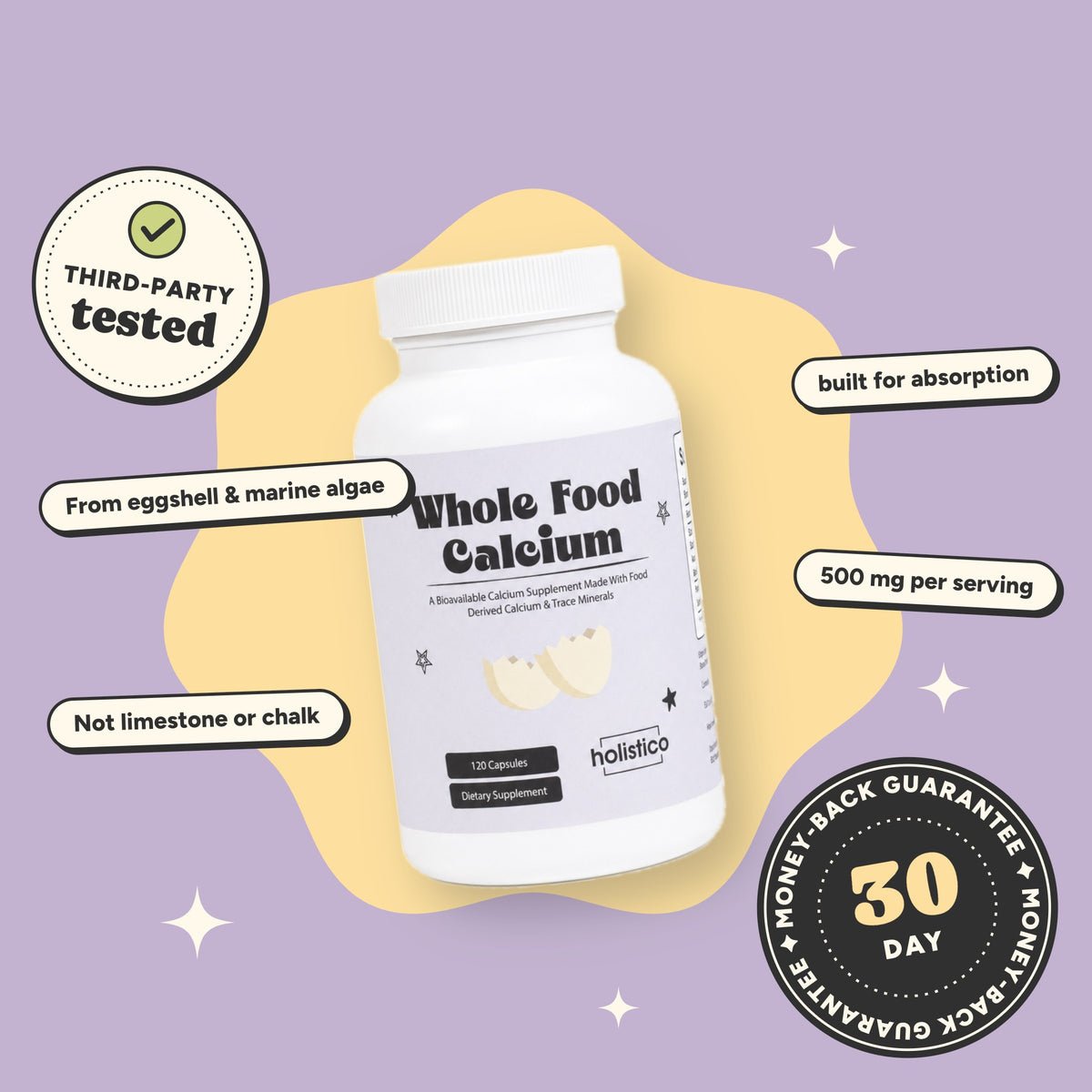
A whole food calcium supplement gives you calcium the way food does: from real food, with the companion minerals it travels with in nature, in a form your body recognizes. Katie, RHN, FDN-P, made Whole Food Calcium from upcycled eggshells and Atlantic red algae, so your calcium arrives as food, not rocks. Each serving has 500 mg of calcium, and the algae brings more than 70 trace minerals along with it. This product contains egg.
Why calcium matters for skin, bones and nerves
Calcium matters for skin because the calcium gradient in your epidermis helps control skin cell turnover and barrier formation. Skin cells are rebuilt in layers; as new cells move upward they mature and form the barrier that keeps water in and irritants out. Calcium signals direct that process, and when it is off, inflammatory skin problems can get worse. Review: skin barrier and calcium
Calcium also gives bones and teeth their structure and helps muscles, nerves, blood vessels and hormone release work. Almost all of it is stored in bones and teeth, and your body cannot make it, so it has to come from food, drinks and supplements when needed. NIH Office of Dietary Supplements: calcium NIAMS: calcium and vitamin D for bone health
That does not make calcium a stand-alone acne or eczema fix. Katie treats both as internal issues, with the skin showing what is happening inside. Calcium is one nutrient in that picture, beside food intake, gut function, hormones, blood sugar and stress.
Signs of low calcium intake, and who tends to run low
Low calcium intake often has no early sign, because your body pulls calcium from bone to keep blood calcium steady. Your blood can look fine while your bones quietly pay for it, and over time that loss can make bones weak and raise the risk of fractures and osteoporosis. NIAMS: calcium and vitamin D for bone health Daily intake is the real question: are you eating enough calcium, day after day?
Intake is most likely to run low if dairy is off the table, total food intake runs low, or your periods are missing. Katie sees it often when clients cut dairy during gut work and never replace the calcium it was giving them. Postmenopausal women also absorb and retain less calcium over time. NIH Office of Dietary Supplements: calcium Vitamin D belongs in the picture too, since it helps your body absorb calcium.
Why most calcium supplements miss the mark
Most calcium supplements start as limestone rock, heavily processed into calcium carbonate. Rock is cheap, but it is not food, and the result is a lone mineral salt with none of the supporting nutrients calcium travels with in a meal.
Food still comes first in Katie’s practice. Milk, yogurt and cheese are major food sources of calcium. Sardines and salmon eaten with their bones also provide calcium, as do kale, broccoli and Chinese cabbage. NIH Office of Dietary Supplements: calcium A supplement earns its place when those foods are not covering the need, never as a cover for chronic under-eating.
Whole food vs. synthetic: why the form matters
Katie is honest about the chemistry: eggshell calcium is calcium carbonate. The difference is the source and the nutrient matrix. Eggshell arrives as a food, formed inside a living system. Marine algae draws minerals from seawater and builds them into its own structure as it grows, so its calcium comes with naturally occurring magnesium and more than 70 trace minerals. Limestone carbonate is dug up and ultra processed, with no supporting nutrients at all, and it is a mineral form your body has to work harder to use, because it is not a form food ever delivers. One is calcium the way it shows up in food. The other is ground up rock.
Dosing tells the same story. Synthetic minerals are often dosed like drugs, not food: one huge dose of a lone mineral, far beyond what a meal would ever deliver. Nutrients compete as well as cooperate, and a flood of one mineral can crowd out its relatives. Food delivers calcium in moderate amounts across the day, alongside magnesium and trace minerals. This formula follows the food pattern: 500 mg servings, split across the day, family included.
The rest of the capsule matters just as much. Most supplements on the market are loaded with cheap fillers, flow agents, artificial colors, binders and coatings. They exist for high speed manufacturing, long shelf life and uniform looking capsules, not for the person swallowing them. They add daily exposure to ingredients with no nutritional purpose, and the gut-irritating, inflammation-driving ones work directly against the reason people take supplements for skin and gut support.
Holistico’s formula has none of it. No synthetic additives. Just real, nutrient dense foods with a purpose.
Third-party tested, every single batch
Every batch is tested twice over: the manufacturer tests each batch for potency, identity, heavy metals and microbes, then an independent third-party lab tests it again for heavy metals and microbial safety. In the published third-party results, mercury, lead, arsenic and cadmium all came back way below their limits, and the microbiology panel came back all clear. The capsules are made in an FDA-registered, cGMP-certified facility in Hauppauge, New York. Certificates of Analysis and third-party lab reports are available on request: you do not have to take Katie’s word for any of it.
What makes a whole food calcium supplement different
Just three whole food ingredients do the work:
- Eggshell calcium: 500 mg per serving, 38% of the daily value, from upcycled eggshells, a concentrated food source at about 380 mg of calcium per gram, with bioavailability comparable to calcium carbonate at about 39%. Study: chicken eggshell for dietary calcium intake Review: food-based ways to improve calcium intake
- Marine algae: a red algae that pulls minerals from seawater and builds them into its own skeleton, bringing naturally occurring magnesium and more than 70 trace minerals with its calcium. Minerals work best as a team.
- Horseradish tree leaf, 60 mg: the whole leaf, a natural source of plant phytonutrients, magnesium and trace minerals, the same supporting nutrients found in calcium-rich whole foods.
Katie does not claim eggshell calcium is magic. The value is the source: real eggshell and marine algae in a short, clean formula, instead of calcium pulled from limestone rock.
Allergen note, stated plainly: Whole Food Calcium contains egg, because it is made with eggshell calcium. It is not a fit for someone with an egg allergy. It contains no dairy.
How to use Whole Food Calcium
The label suggests two capsules twice daily with food. Splitting the day suits how calcium absorbs: it is absorbed best at 500 mg or less at one time, and one serving here is exactly 500 mg. NIH Office of Dietary Supplements: calcium One bottle costs $45, has 120 capsules, and lasts a full month at the label dose. Keep total intake from food and supplements in view; more is not the goal.
Timing matters with some medicines. Calcium can interfere with how levothyroxine and some antibiotics absorb, so check the timing if you take one of those medicines. NIH Office of Dietary Supplements: calcium
Subscribe and Save keeps you consistent: 10% off deliveries every 30 days, 15% every 60 days, or 20% every 90 days, free shipping, and you can skip, pause or cancel at any time. Calcium and vitamin D are natural partners, so many people choose the discounted bundle of Whole Food Calcium with Katie’s Whole Food Vitamin D.
The bottom line
Your body was built to get calcium from food, not from rocks. Whole Food Calcium delivers 500 mg per serving from eggshells and marine algae, with the trace minerals food would bring, third-party tested in every batch. It holds a 5 star rating across 5 reviews in Katie’s shop, and subscribing saves up to 20% with free shipping.
If low intake is tied to gut issues, missing periods or skin that will not settle, a capsule is only one part of the plan. You can work with us to find the root cause and build support around the whole picture.
Frequently Asked Questions
What is a whole food calcium supplement?
A whole food calcium supplement gets its calcium from food instead of limestone rock, so it arrives with the companion minerals it travels with in food. Katie’s formula uses eggshell calcium plus marine algae, and each two-capsule serving has 500 mg of calcium.
Is eggshell calcium absorbed well?
Yes. Eggshell calcium has bioavailability comparable to calcium carbonate, at about 39%, and it arrives as a food with its natural nutrient matrix, not as an ultra processed mineral salt.
Is Whole Food Calcium third-party tested?
Yes, every batch, twice: once by the manufacturer and once by an independent third-party lab, for heavy metals and microbial safety. The lab reports are available on request.
Does Whole Food Calcium contain egg?
Yes. Whole Food Calcium contains egg, because it is made with eggshell calcium. Do not use it if you have an egg allergy.
Sources
- NIH Office of Dietary Supplements: calcium
- NIAMS: calcium and vitamin D for bone health
- Review: skin barrier and calcium
- Study: chicken eggshell for dietary calcium intake
- Review: food-based ways to improve calcium intake
Editorial update: 1 November 2026. This article provides general education and does not make an individual diagnosis.