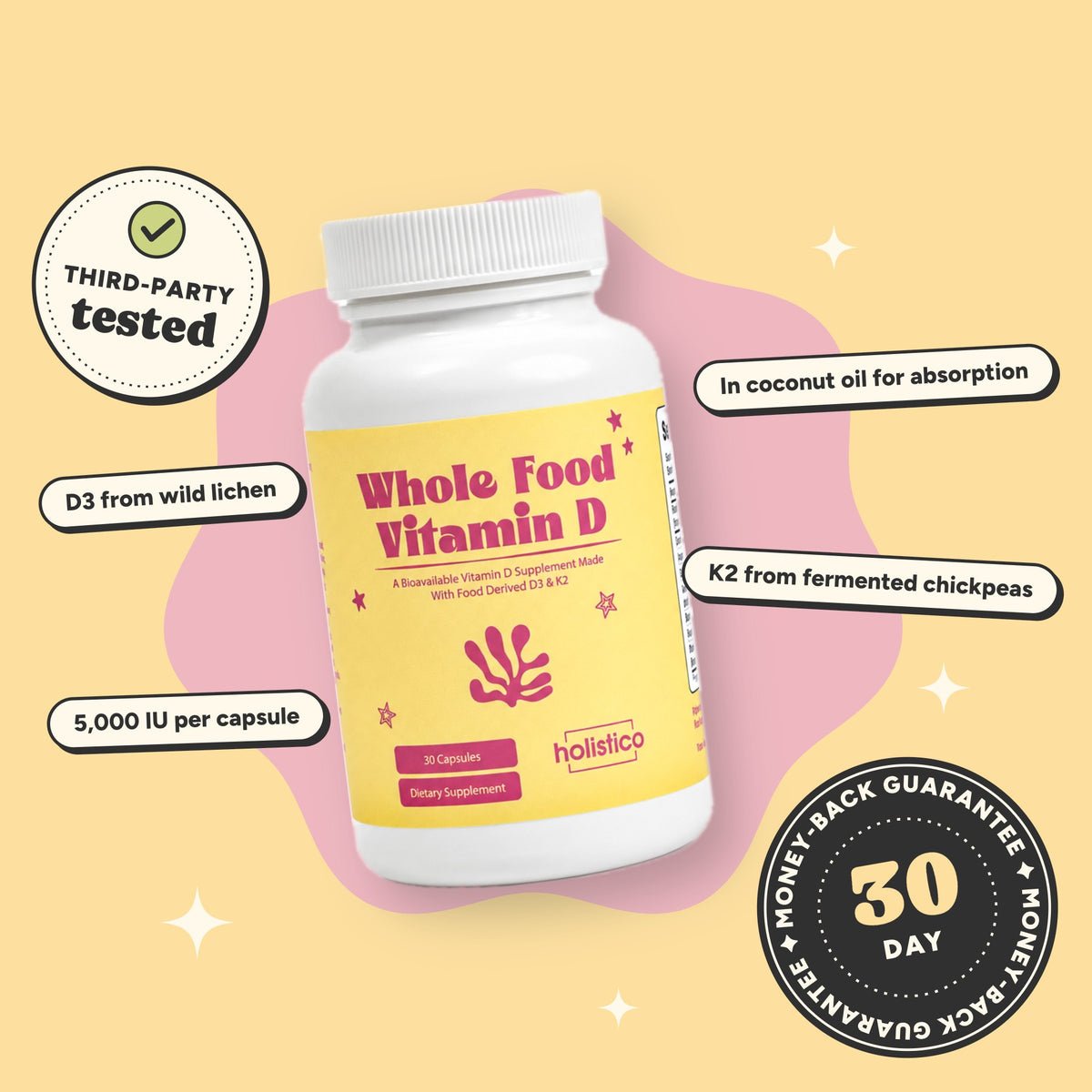
Whole food vitamin D starts as food, not as a lab isolate, so the nutrient arrives with its natural co-factors and companion nutrients, in a form your body recognizes. That is the vitamin D Katie, RHN, FDN-P, built. Her Whole Food Vitamin D gets its D3 from wild-harvested lichen, which makes vitamin D from sunlight the same way your skin does, wrapped in real food: K2, beef liver, marine algae and coconut.
Why whole food vitamin D matters for skin and more
Vitamin D helps regulate skin cell growth, immune defense and the skin barrier. It also helps your body absorb calcium and supports bones, muscles and nerves. NIH Office of Dietary Supplements: vitamin D
Vitamin D signaling in skin cells helps control how they grow and mature, and supports antimicrobial defense and a steadier immune response in the skin. Review: vitamin D in inflammatory skin diseases That is why Katie looks at vitamin D when acne or eczema keeps returning.
The acne research adds another reason to pay attention: a systematic review found that 8 of 10 studies reported lower vitamin D status as acne severity increased, though the review does not prove low vitamin D causes acne. Systematic review: vitamin D levels and acne severity
In Katie’s practice, low vitamin D is one piece of a bigger internal picture: gut issues, blood sugar swings, stress, thyroid concerns, other nutrient gaps. A supplement does not replace that root cause work, and skincare stays simple alongside it. Gentle, minimal care supports the barrier, but products on the surface cannot fix low nutrient status inside.
Signs you may be running low on vitamin D
Low vitamin D can be silent for years. When deficiency does show, it can look like bone pain and muscle weakness, and long-term deficiency can soften bones, a condition called osteomalacia. NIH Office of Dietary Supplements: vitamin D
You are more likely to run low if you get little sun, cover your skin outdoors, have darker skin, or are an older adult, and the same goes if a gut condition limits fat absorption, because vitamin D is absorbed with fat. People with obesity or weight loss surgery may need more as well. NIH Office of Dietary Supplements: vitamin D
Food and sunlight come first, but for many people they are not enough: few foods carry much vitamin D, long winters cut off the sun for months, and indoor work keeps most people out of it. That is where a well made supplement earns its place: it fills the gap food and sunlight leave, in a form your body can use.
Why most vitamin D supplements miss the mark
Most D3 supplements are made from lanolin, the grease scraped from sheep’s wool, pushed through industrial solvent extraction and chemical conversion to become a usable vitamin. What lands in the capsule is a lone synthetic isolate, nothing like vitamin D in food, which arrives with fat and companion nutrients.
Many cheap products use D2 instead, even though D3 is the form your skin makes in sunlight and research shows it raises and sustains vitamin D status more effectively.
Katie is not against supplements, only synthetic isolates bought without a clear reason, stacked on other products, and taken just because. A whole food form starts with a better question: where is the gap, and what fills it the way food would?
Whole food vs. synthetic: why the form matters
This is the part most supplement labels hope you never think about. A synthetic isolate is a single nutrient made in a lab, on its own. A whole food supplement starts from food, so the nutrient arrives with the natural co-factors it travels with in nature. Your body recognizes nutrients in that context, because that is how it has always received them: vitamin D in food comes with fat for absorption and works alongside K2, magnesium and retinol. A lone lab made copy gives you the one nutrient, none of the team, and a chemical copy that can differ in structure and behavior from the food form, so your body has to work harder to use it.
Dosing tells the same story. Synthetic isolates are often mega dosed far beyond food levels and sent in alone, with none of their nutrient family. Nutrients compete as well as cooperate, so a lone high dose of one can crowd out its relatives. Vitamin D without vitamin A, K2 and magnesium is exactly that problem. In food, and in this formula, the family arrives together.
Then there is everything else in the capsule: most supplements are loaded with cheap fillers, flow agents, artificial colors, binders and coatings. None of them are there for you. They exist to make high speed manufacturing easier and shelf life longer, so powder runs smoothly through machines and every capsule looks uniform on a shelf. They add daily exposure to ingredients with no nutritional purpose, and the gut-irritating, inflammation-driving ones work directly against the reason people take supplements for skin and gut support. Swallowing an inflammatory additive every day, inside a product bought to calm inflammation, makes no sense to Katie.
Holistico’s formula has none of it. No synthetic additives. Just real, nutrient dense foods with a purpose.
Third-party tested, every single batch
Every batch is tested twice over: the manufacturer tests each batch for potency, identity, heavy metals and microbes, then an independent third-party lab tests it again for heavy metals and microbial safety. In the published third-party results, mercury, lead, arsenic and cadmium came back way below their limits, and microbiology came back all clear. The capsules are made in an FDA-registered, cGMP-certified facility in Hauppauge, New York. Certificates of Analysis and third-party lab reports are available on request: you do not have to take Katie’s word for any of it.
What makes Whole Food Vitamin D different
Each capsule has 125 mcg, or 5,000 IU, of vitamin D3, delivered by a short list of foods chosen to work as a team:
- Vitamin D3 from wild-harvested lichen: lichen soaks up the sun and makes D3, the same biological process your own skin uses.
- Vitamin K2, 50 mcg: MenaQ7 from fermented non-GMO chickpeas. Vitamin D helps your body take up calcium, K2 supports normal calcium metabolism, and vitamin K helps make proteins involved in bone metabolism. NIH Office of Dietary Supplements: vitamin K
- Beef liver powder, 150 mg: beef liver has naturally occurring retinol, the active form of vitamin A. Vitamin D’s receptor must pair with a partner receptor that vitamin A activates before cells can respond to it, so D works best with A beside it.
- Marine algae: a red algae that builds its skeleton from minerals drawn out of seawater; has naturally occurring magnesium.
- Coconut flesh oil powder: a stable, food-based fat, included because vitamin D is fat soluble and absorbed alongside fat. NIH Office of Dietary Supplements: vitamin D
- Moringa leaf, black pepper and rosemary: the whole leaf, not an extract; black pepper to support absorption; rosemary as a natural antioxidant.
Allergen note: contains tree nuts (coconut) and beef liver, so it is not vegetarian or vegan. It contains no egg.
How to use Whole Food Vitamin D
Take one capsule daily with food. One bottle costs $39, has 30 capsules, and lasts a month.
The dose is strong on purpose, so use it as the vitamin D in your plan, not stacked on other vitamin D products. The standard adult upper limit is 4,000 IU per day from all sources; a clinician may use a higher dose for a set time to correct a deficiency. NIH Office of Dietary Supplements: vitamin D If you take a blood thinner, check with your prescriber first, because vitamin K intake needs to stay consistent with that medication. NIH Office of Dietary Supplements: vitamin K
Consistency is what makes vitamin D work, and Subscribe and Save keeps you consistent. Save 10% on deliveries every 30 days, 15% every 60 days, or 20% every 90 days. Subscriptions ship free, and you can skip, pause or cancel at any time. Best value, and you never run out mid-routine.
The bottom line
If you are going to take vitamin D, take it the way food delivers it: the nutrient plus its team, from sources your body recognizes. Whole Food Vitamin D gives you lichen-sourced D3 with K2, beef liver, marine algae and coconut, third-party tested in every batch. It holds a 5 star rating across 7 reviews in Katie’s shop, and subscribing saves up to 20% with free shipping.
If your skin keeps breaking out while you guess at supplements, Katie’s root cause work may be the better next step. You can work with us to build a plan around your whole picture.
Frequently Asked Questions
What is whole food vitamin D?
Whole food vitamin D is vitamin D that starts from food ingredients rather than a compound isolated in a lab. In Katie’s formula, the D3 comes from wild-harvested lichen and the K2 from fermented non-GMO chickpeas, and the rest of the capsule is food too: beef liver, marine algae, coconut, moringa, black pepper and rosemary.
Why is most vitamin D3 made from sheep grease?
Because lanolin, the grease in sheep’s wool, is cheap and easy to produce at scale, even after industrial solvent extraction and chemical conversion turn it into D3. Katie chose lichen instead: it makes D3 directly from sunlight, the same way your skin does.
Is Whole Food Vitamin D third-party tested?
Yes, every batch, twice: once by the manufacturer and once by an independent third-party lab, for heavy metals and microbial safety. The lab reports are available on request.
Does Whole Food Vitamin D contain egg?
No, it contains no egg. It does contain tree nuts, from coconut, so it is not a fit if you must avoid coconut.
Sources
- NIH Office of Dietary Supplements: vitamin D
- Review: vitamin D in inflammatory skin diseases
- Systematic review: vitamin D levels and acne severity
- NIH Office of Dietary Supplements: vitamin K
- NIAMS: calcium and vitamin D for bone health
Editorial update: 1 November 2026. This article provides general education and does not make an individual diagnosis.